JEREMIE LENOIR
2026
Extrait de la monographie FOSSIL aux éditions Light Motiv
Des paysages sans dehors
Landscapes without an outside
La Terre n’a pas d’autre issue que de devenir invisible : en nous, qui participons pour une part de nous-même à l'Invisible [...], en nous seulement peut s’accomplir cette transfiguration intime et durable du Visible en Invisible... Rainer Maria Rilke - Lettre à W. Von Hulewicz du 13 novembre 1925
The earth has no other refuge than to become invisible: in us who with part of our being partake of the Invisible […], in us alone can this intimate and enduring transformation of the visible into an invisible no longer dependent on being visible and tangible be accomplished. Rainer Maria Rilke - Letter to W. von Hulewicz on November 13, 1925
Penser au paysage me ramène inexorablement au même souvenir. Dans l’incandescence d’une brume matinale, là où le ciel vient s’épandre sur les reflets d’un cours d’eau pour en effacer l’horizon, un maelstrom dévore l'espace jusque dans sa propre disparition. Assis sur un banc de la Tate Britain face à Norham Castle, Sunrise de Joseph Mallord William Turner, me voilà plongé tout entier non dans le réel mais dans l’intensité de son atmosphère ; ébloui par un paysage qui, dans les yeux d’un enfant de douze ans, ne ressemblait plus à ce que je savais voir mais à ce que je pouvais ressentir. L’émerveillement n’était plus seulement celui de l’intransigeante beauté de l’œuvre, ni celui, plus fortuit, de la scène elle-même, mais bien celui qui convoquait mes propres sens, celui qui trompait ma raison, celui qui me faisait croire à ce mirage sublime dans lequel j’aurais moi aussi, un jour, arpenté le sentier qui mène au Norham Castle.
Thinking about landscapes invariably brings me back to the same memory. In the incandescent glow of a morning mist, where the sky spills across the reflections of a river and dissolves the horizon, a maelstrom consumes space into its own disappearance. Sitting on a bench at Tate Britain in front of Norham Castle, Sunrise by Joseph Mallord William Turner, I found myself immersed not in reality, but in the intensity of its atmosphere; dazzled by a landscape that, through the eyes of a twelve-year-old child, no longer resembled what I knew to be seeing but rather what I was capable of feeling. The sense of wonder was no longer merely one inspired by the uncompromising beauty of the work, nor even by the scene it depicted, but by something summoning my own senses, deceiving my reason, leading me to believe in this sublime mirage in which I too might one day walk the path to Norham Castle.
Dans ses œuvres, Turner ne cherche pas à représenter le paysage comme une réalité objective ; il le soumet dans une forme qui porte en elle la trace de sa propre existence. Pour lui, la vérité ne réside pas dans la précision des contours, mais dans la lumière vibrante qui révèle le tumulte des particules, dans cette brume qui se fait voile du monde des choses pour nous permettre d’accéder à l’intuition sensible. Ce que je crois connaître de cette campagne anglaise, comme de toutes les autres campagnes, s’effrite pour laisser jaillir la puissance silencieuse et éclatante de son ambiance : le Stimmung. Si la vérité n’est pas celle, ou uniquement celle, de la matérialité du paysage, de ce château perché sur la colline, de cette rivière où les animaux s’abreuvent, elle devient au moins, en partie, quelque part, ma vérité.
In his paintings, Turner does not seek to represent landscapes as an objective reality; he subjects it to a form that bears within it the trace of its own existence. From his perception, truth lies not in the precision of contours, but in the vibrating light that reveals the turmoil of particles, in that mist which becomes a veil cast over the world of things, allowing us to access sensory intuition. What I believe I know of the English countryside, as of all others, begins to crumble, giving way to the silent yet radiant force of its atmosphere: its Stimmung. If the truth is not—or not solely—that of the landscape’s materiality, of the castle perched upon the hill, of the river where animals come to drink, then it becomes, at least in part, somewhere, my own truth.
*
Qu’il évoque un lieu traversé ou une représentation artistique, le paysage est un monde en soi où se mêlent des fragments de mémoire, de vécu, d’émotion... Ce sont les strates qui, se juxtaposant et s’entrelaçant, donnent l’épaisseur au visible. En offrant une prise au regard, un espace à la rêverie, un rythme à la marche, le paysage vit et s’inscrit en nous : nous l’habitons. Cette notion fondamentale de « l’habiter », Martin Heidegger la définit non comme l’occupation d’un espace, mais comme l’appartenance à un monde. Le lieu n’est pas un cadre neutre, il est ce qui rassemble — ce qu’il nomme le Geviert1. Le géographe Yi-Fu Tuan, quant à lui, distingue les termes space et place2 : l’espace devient lieu lorsqu’il est investi de souvenirs, d’usages, d’affects. Il est autant une construction mentale que matérielle.
Whether it evokes a place once wandered or an artistic representation, landscapes are worlds unto themselves, where fragments of memory, lived experience, and emotion converge. These are the layers that, through their juxtaposition and interweaving, lend depth to the visible. By offering a hold for the gaze, a space for reverie, a rhythm for walking, a scenery lives within us and inscribes itself upon us: we dwell on it. This fundamental notion of dwelling was defined by Martin Heidegger not as the occupation of space but as belonging to a world. A place is not a neutral setting; it is that which gathers together what he calls the Geviert.1 The geographer Yi-Fu Tuan, on his end, distinguishes between space and place:2 space becomes a place when it is invested with memories, practices, and affects. It is as much a mental construction as it is a material one.
Toutefois, depuis près d’un siècle, la société capitaliste a parasité cette relation en écartant l’homme et en plaçant le gain au centre de son urbanisation : accélération des flux, condensation de l’espace, rentabilité du sol. Nous n’avons eu de cesse d’uniformiser nos territoires, de les organiser comme un échiquier standardisé, fonctionnel, optimisé, élaborant, au passage, un nouveau langage universel dont les sigles s’inscrivent dans la terre comme autant de patterns analogues et aseptisés. Industries, plateformes de stockage, hubs routiers, ferroviaires, portuaires ou aéroportuaires, zones commerciales ou résidentielles… ce que nous bâtissons aujourd’hui, l’héritage de notre génération, ne cherche plus à s’inscrire dans les écosystèmes natifs, ni dans les logiques historiques ou culturelles qui ont forgé l’identité des territoires. Peu à peu, le vernaculaire s’est évaporé face à l’avidité entropique. Peu à peu, l’Anthropocène a redéfini la cohabitation de l’Homme avec la Nature.
Yet for nearly a century, capitalist society has disrupted this relationship by suppressing the human subject and placing profit at the centre of urban development: the acceleration of flows, the compression of space, the optimisation of land value. We have relentlessly homogenised our territories, organising them as a standardised, functional, optimised chessboard, while simultaneously elaborating a unique universal language whose acronyms are inscribed upon the earth as recurring, sanitised patterns. Industrial complexes, storage platforms, roads, rails, naval and airport hubs, commercial and residential zones—what we build today, our generation’s legacy, no longer seeks to embed itself within native ecosystems, nor within the historical and cultural logics that once shaped the identity of territories. Gradually, the vernacular has evaporated before the entropic force of greed. Gradually, the Anthropocene has redefined the terms of coexistence between humankind and nature.
*
Nous assistons à un basculement qui peut être lu comme le passage d’un monde à un non-monde, d’une cartographie de lieux à un amoncellement de non-lieux. Non pas un chaos absolu, mais une condition dans laquelle les structures de sens ne se laissent plus rassembler dans une unité signifiante. L’Anthropocène révèle une disjonction majeure : la désynchronisation entre nos cadres de pensée et la réalité matérielle que nous contribuons à produire.
We are witnessing a shift that may be understood as the passage from a world to a non-world, from a cartography of places to an accumulation of non-places. Not absolute chaos, but a condition in which structures of meaning can no longer be hinged into a coherent whole. The Anthropocene reveals a profound disjunction: the growing desynchronisation between our conceptual framework and the material reality we still produce.
Le paysage contemporain ne peut plus aujourd’hui être appréhendé comme une évidence sensible. Il est pris dans une tension qui le rend, sinon invisible, du moins insaisissable. Cette impossibilité apparaît moins comme une disparition que comme une altération profonde de notre rapport au monde. Si on ne questionne pas la rudesse de l’asphalte, on s’accommode silencieusement du sacrifice qu’il perpétue dans le vivant. Avons-nous d’ailleurs un autre choix ? Subsiste-t-il un projet paysager commun et démocratique face aux logiques économiques ? Cette mise à l’écart, cette confiscation du paysage par le libéralisme utilitariste, induit une forme d’automatisme amnésique, comme un état de choc, provoquant un effacement de ces lieux, une destitution de leur statut de paysages. Par sa normalisation lisse et ses mutations constantes, le territoire devient un simulacre qui ne renvoie désormais plus à une profondeur, mais, comme le suggérait Baudrillard3, à sa propre reproductibilité. Cette perte de profondeur est aussi une perte de résonance. Hartmut Rosa décrit un monde moderne devenu « muet »4 : les choses ne nous parlent plus, à moins que nous ne sachions plus leur répondre.
Today, the contemporary landscape can no longer be approached as a self-evident sensory experience. It is ensnared in a tension that renders it, if not invisible, then at least elusive. This impossibility appears less as a disappearance than as a profound alteration of our relationship to the world. If we no longer question the harshness of asphalt, we silently accommodate the sacrifice it exacts from the living world. Do we, in fact, have any other choice? Does a shared and democratic landscape project still survive in the face of economic imperatives? This marginalisation, this confiscation of scenery by utilitarian liberalism, induces a form of amnesiac automatism—a state akin to shock—leading to the erasure of these places and revocation of their status as landscapes. Through its smooth normalisation and perpetual transformation, territory becomes a simulacrum that no longer refers to any depth but, as Baudrillard suggested, to its own reproducibility.3 This loss of depth is also a loss of resonance. Hartmut Rosa describes a modern world that has become “mute”:4 things no longer speak to us, unless perhaps we don’t know how to answer them anymore.
Tout y est utile, mais rien n’y appelle le retour. Il ne demande ni effort, ni fidélité. Il se donne d’un coup, et s’oublie dans le même geste. L’excès jusqu’à l’absence. Comme si, dans sa clarté immédiate et sa neutralité programmée, le paysage renonçait à cette promesse de devenir un monde pour quelqu’un
Everything in it is useful, yet nothing beckons to it. Demanding neither effort nor fidelity. Giving itself all at once and forgotten in the same gesture. Excess to the point of absence. As though, in its immediate legibility and programmed neutrality, landscape had abandoned its promise of becoming a world for someone.
*
Dans ce nouveau paradigme, ce que je nommerai le junk paysage fait face à une double saturation : celle de l’espace, de la cannibalisation des sols, et celle de sa représentation, du flux constant des images. Dès lors, il nous impose un paradoxe : s’il n’a jamais été aussi lisible, nous avons perdu notre capacité à le déchiffrer. L’abstraction photographique devient alors le lieu d’une expérience limite : elle permet la confrontation du regard à ce qui ne peut plus être vu, à ce qui a perdu sa familiarité et son intelligibilité. Ce choix n’est pas une fuite mais un retrait nécessaire engageant l’image dans une dimension plastique plutôt que politique.
Within this new paradigm, what I call the junk landscape faces a double saturation: that of space itself, through soil cannibalization, and its representation, through the incessant flow of images. It therefore confronts us with a paradox: although it has never been more visible, we have lost the ability to decipher it. Photographic abstraction becomes the site of a converging experience, confronting the gaze to what can no longer be seen and what has lost both its familiarity and its intelligibility. This choice is not an act of withdrawal from reality but a necessary retreat, one that engages the image within a plastic rather than political dimension.
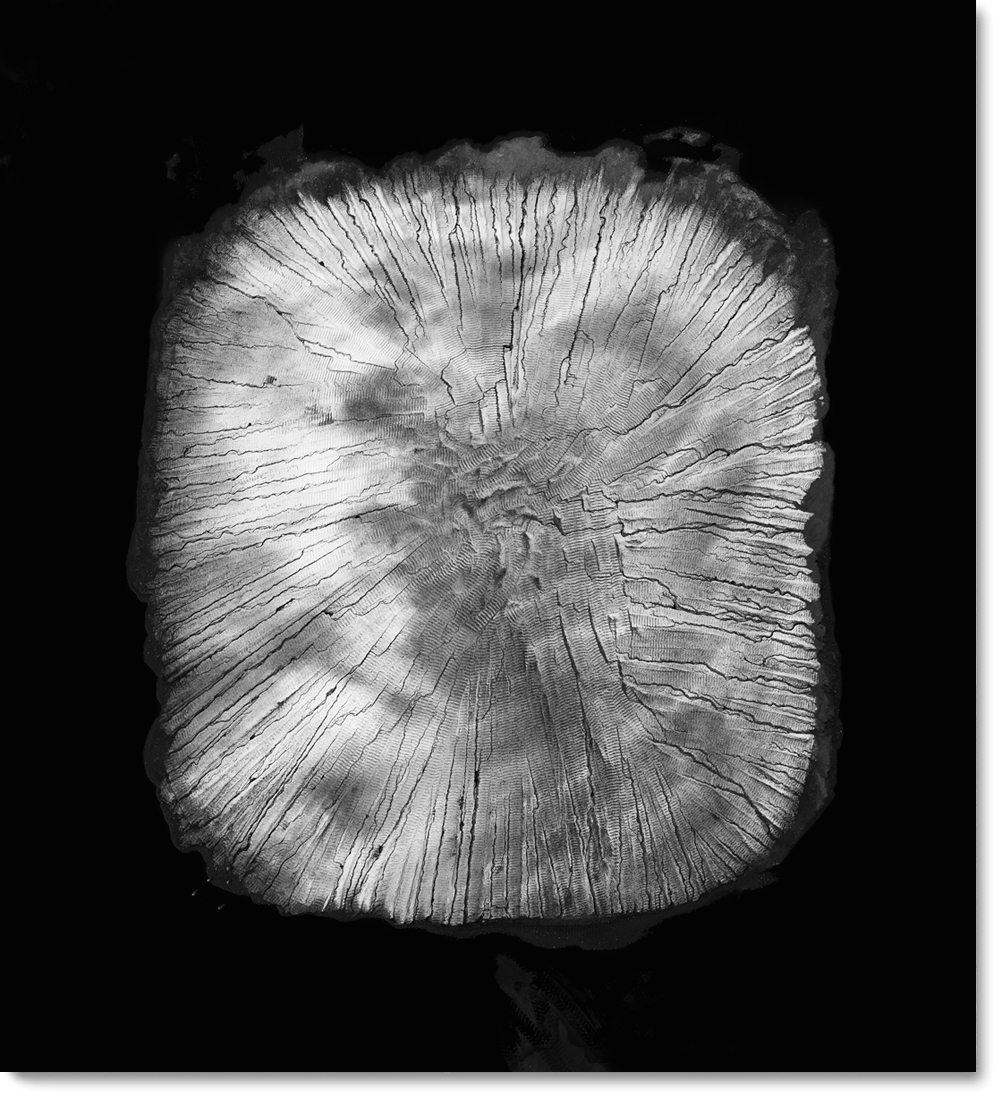
Le piège serait celui d’une neutralisation critique par la beauté formelle, celui d’une ambiguïté dans laquelle la catastrophe deviendrait séduisante. S’il faudrait tout d’abord accepter notre propre fascination pour le chaos et la puissance émotionnelle du contexte mortifère, nous devons aussi acter que l’esthétique de ces espaces n’a aucun lien direct avec leur nature intrinsèque. Les photographies de FOSSIL ne recourent à aucun subterfuge ou manipulation esthétisante : les trouver belles ne résulte que de notre propre projection intellectuelle, d’un dialogue qui, consciemment ou non, s’ouvre avec la peinture, le graphisme ou les signes. Ainsi, l’émotion se déploie sur un autre plan que le discours militant, et là est d’ailleurs le principal enjeu : alors que la photographie documentaire prétend encore saisir le réel dans sa lisibilité brutale (catastrophes, pollution, démesure…), alors qu’elle impose un point de vue – légitimement – négatif et moraliste sur ces paysages, elle instaure une distance infranchissable avec son sujet qui inhibe toute possibilité d’appropriation à ce monde, à notre monde. En décalquant crûment ce qu’elle dénonce, elle se rend invisible car elle nous demande l’inacceptable : être partie prenante de la dystopie. L’abstraction, elle, renonce à la transparence. Car comment contenir dans une image ce qui déborde toute échelle humaine ?
The risk lies in the critical neutralisation produced by formal beauty, in an ambiguity through which catastrophe itself becomes seductive. While we must first acknowledge our own fascination with chaos and with emotional force of these deadly environments, we must also recognise that the aesthetic appeal of such spaces bears no direct relation to their intrinsic nature. The photographs in FOSSIL require no artifice, no aesthetic manipulations: if we find them beautiful, it is only through our own intellectual projection, through a dialogue that consciously or unconsciously unfolds with painting, graphic design, and symbols. Emotion therefore operates on a plane other than that of activist discourse, and this is, in fact, the central stake. While documentary photography still claims to grasp reality through its brutal legibility—catastrophe, pollution, excess, environmental devastation—and while it imposes a legitimate critical and moral perspective on these landscapes, it simultaneously establishes an insurmountable distance from its subject, one that inhibits any possibility of inhabiting or acquiring this world, our world. By crudely tracing what it denounces, it becomes invisible because it requests the unacceptable from us: to participate in the dystopia. Abstraction, on the other hand, gives up transparency. For how can one image contain what goes beyond every human scale?
*
Voir, ce n’est jamais saisir une surface, mais entrer dans une chair du monde, une dimension sensible. Prolongeant cette perspective, l’abstraction retranscrit le monde non comme il est, mais comme il se dérobe à la rationalité. Loin de trahir le paysage, elle rend manifeste ce qui habituellement nous est imperceptible. Elle tente de révéler une vérité qui se trouve dans cette part du temps qui ne peut être contenue dans la durée. Dans une mécanique nietzschéenne, l’abstraction répond alors à une nécessité d’insuffler du sens et de créer un monde à notre mesure. Il ne s’agit plus d’un environnement qui nous est imposé par le réel brut, mais de celui qui naît de notre propre volonté – volonté d’évasion, volonté de création, volonté de surmonter ce qui semble écrit et de donner naissance à une autre réalité, plus vibrante, plus tangible. L’attention portée à l’échelle, la couleur, la matière ou la composition enclenche un processus de transfiguration du réel en tableaux offrant la distance et le temps nécessaire au paysage d’exister dans l’image. L’abstraction nous donne à voir autrement : non pas seulement ce qui apparaît et se tient face à nous, mais ce qui, en se retirant, rend l’apparition possible. L’Aléthéia.
Seeing is never a matter of apprehending a surface; it is an entry to the flesh of the world, to a sensory dimension. Extending this perspective, abstraction translates the world not as it is but as eluding rationality. Far from betraying the scenery, it manifests what ordinarily escapes perception. It seeks to reveal a truth residing in that sliver of time which no duration can contain. In a Nietzschean sense, abstraction responds to the necessity of imbuing the world with meaning and creating one commensurating with our own measure. It is no longer an environment imposed on us by brute reality but one born from one’s own will —a will to escape, a will to create, a will to overcome what appears predetermined and to bring forth another reality, more vibrant, more tangible. The attention paid to scale, colour, materiality, and composition initiates a process, transfiguring reality into images that provide the distance and time necessary for landscapes to exist within representation. Abstraction enables us to see otherwise: not only what appears and stands before us, but also that which, when withdrawing, emerges. Aletheia.
Ce déplacement incite aussi à une remise en question de l’anthropocentrisme. En abandonnant la perspective stable et le point de vue dominant, l’abstraction dissout la position centrale du sujet humain. Le regard n’organise plus le monde ; il s’y perd. L’oeil ne se détourne pas du réel ; il plonge, au contraire, dans toute sa vulnérabilité. Ce trouble perceptif ouvre la possibilité d’une autre relation au paysage, moins fondée sur la maîtrise et le cynisme que sur une forme d’humilité et d’empathie. L’image, libérée du contexte et du propos, cesse d’être une fenêtre pour devenir un champ d’expression de l’essence pure du visible. Le spectateur n’est plus face à un territoire limpide mais se retrouve livré à lui-même, tourmenté entre la contemplation poétique et cet inexorable questionnement : que voyons-nous ? Des roches au microscope ? Les rides d’une main ? Des icebergs à la dérive ? Ou ne serait-ce pas plutôt l’ersatz d’une toile de Malevitch, Ryman, Tàpiès ou Soulages ? Instinctivement, nous projetons dans ces photographies nos propres références artistiques comme notre vision d’un monde enfantin, onirique, scientifique ou purement sensoriel… En les décryptant, en élaborant notre propre retour au réel, nous opérons une immersion symbolique et spirituelle, nous intériorisons notre propre vérité, nous arpentons notre propre sentier. Nous y lisons des cosmogonies multiples encourageant chacun à nourrir, par l’imaginaire, l’intimité nécessaire pour se lier au monde qui nous entoure.
This displacement also invites a reconsideration of anthropocentrism. By relinquishing stable perspective and the dominant point of view, abstraction dissolves the central position of the human subject. The gaze no longer holds the world together; it drifts within it. The eye does not turn away from reality; on the contrary, it plunges into it in all its vulnerability. This perceptual disorientation opens the possibility of another relationship to landscapes; one founded less on mastery and cynicism than on humility and empathy. Freed from context and discourse, the image ceases to function as a window and, instead, becomes a field in which the pure essence of the visible may unfold. The viewer is no longer faced with a clear territory but is left to navigate alone, suspended between poetic contemplation and an inexorable question: what is it we see? Rocks underneath a microscope? Wrinkles on a hand? Drifting icebergs? Or perhaps the ersatz of a canvas by Malevich, Ryman, Tàpies, or Soulages? Instinctively, we project onto these photographs our own artistic references, as well as our visions of a world that is childlike, dreamlike, scientific, or purely sensory. As we decipher them and shape our own return to reality, we enter into a symbolic and spiritual immersion. We internalise our own truth. We walk our own path. Within them, we encounter multiple cosmogonies, each inviting us to cultivate, through imagination, the intimacy required to forge a bond with the world around us.
Alors, regardez.
Ce sont des paysages sans dehors.
Des lieux où l’on ne peut aller mais qui, pourtant, accueillent nos songes.
Des terres obscures qui ne se donnent qu’à celui qui accepte de ne rien voir — et de laisser la lumière venir autrement.
So look.
These are landscapes without an outside.
Places to which one cannot go and yet which welcome our dreams.
Obscure territories that reveal themselves only to those willing to see nothing—and to allow the light to get in by other means.
Jérémie Lenoir
1 Martin Heidegger, Essais et conférences, Editions Gallimard, 1958.
2 Yi-Fu Tuan, Space and Place: The Perspective of Experience, University of Minnesota Press, 1977.
3 Jean Baudrillard, Simulacres et Simulation, Editions Galilée, 1981.
4 Harmut Rosa, Résonance. Une sociologie de la relation au monde, Editions La Découverte, 2018.
1 Essays and Conferences, Martin HeideggerHarper & Row, New York, 1971.
2 Space and Place: The Perspective of Experience, Yi-Fu Tuan, University of Minnesota Press, Minneapolis, 1977.
3 Simulacra and Simulation, Jean Baudrillard, University of Michigan Press, Ann Arbor, 1994.
4 Resonance: A Sociology of Our Relationship to the World, Hartmut Rosa, Polity Press, Cambridge, 2019.
Traduction Harriet Thurgood
FOSSIL
2026
Editions Light Motiv
Découvrir le livre FOSSIL publié en 2026 chez Light Motiv.
Discover the book FOSSIL published in 2026 by Light Motiv.
© Jérémie Lenoir. All Rights Reserved. 2025.